


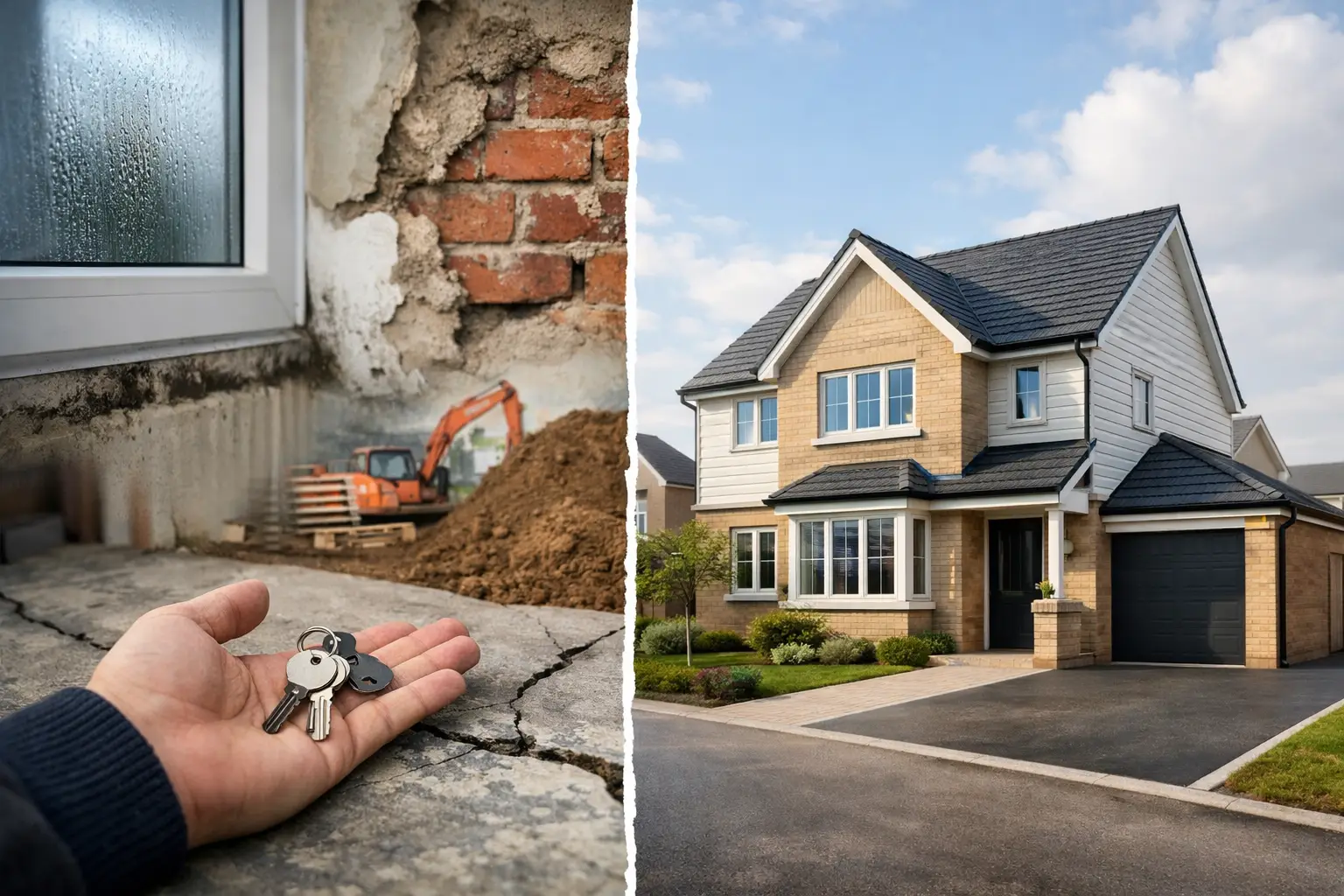
A newly built home can look irresistible on first viewing. Clean lines, untouched finishes and the appeal of being the first owner are powerful advantages. Yet the disadvantages of new build homes are often clearer only after completion, when the practical realities of ownership begin to surface.
For buyers in Marbella and across the Costa del Sol, this matters even more. Many purchases are made from abroad, sometimes off-plan, and often with lifestyle expectations attached – privacy, quality, convenience and long-term value. New developments can absolutely deliver these things, but they do not do so automatically. The finer details deserve close attention.
Why the disadvantages of new build homes deserve a closer look
The strongest marketing around new developments tends to focus on aspiration. Sea views, contemporary architecture, wellness facilities and turnkey presentation are all attractive, particularly for second-home buyers who want simplicity. What is less visible is the gap between brochure promise and lived experience.
That gap is not always dramatic. In many cases, it is simply a question of timing, build quality, hidden costs or resale dynamics. For a discerning buyer, those points are not minor. They shape enjoyment of the property and they influence future value.
1. You often pay a premium for “new”
One of the most common disadvantages of new build homes is price. Developers frequently command a premium for modern design, current building standards, energy efficiency and the emotional pull of a pristine property. In prime areas, that premium can be significant.
Sometimes it is justified. If the development is in a scarce location, offers exceptional amenities or has architectural distinction, a higher entry price may hold up well. But there are cases where buyers pay more simply because the product is new, not because it is better located or more solidly built than an established alternative.
In luxury markets, this point becomes sharper. A beautifully staged new-build villa may be priced well above a mature property nearby with a larger plot, better orientation or a more established address. The question is not whether a premium exists, but whether it is supported by substance.
2. Off-plan purchases come with uncertainty
Buying off-plan can provide access to the best units and early pricing, but uncertainty is part of the package. Plans change. Completion dates shift. Specifications can be adjusted within the contractual framework. Even when the developer is reputable, construction is rarely as predictable as a showroom presentation suggests.
For international buyers, delays can have wider consequences. You may be arranging school calendars, travel schedules, tax residency plans or rental projections around a property that is not yet ready. If completion slips by several months, the inconvenience can be expensive as well as frustrating.
This does not mean off-plan buying is unwise. It means the buyer needs realistic expectations, careful legal review and a clear understanding of what is fixed and what remains subject to change.
3. Snagging issues are common, even at the top end
A new home should feel perfect. In reality, even premium developments often have snagging issues. These may be cosmetic, such as uneven paintwork or poorly aligned cabinetry, or more disruptive, such as drainage faults, air conditioning problems or inadequately sealed windows.
High specification does not eliminate this risk. In fact, the more complex the property – home automation, integrated lighting, climate systems, lifts, spa areas – the more there is to test and fine-tune. Buyers are sometimes surprised to learn that a brand-new residence can require more immediate oversight than a well-maintained resale property.
The key issue is not that defects exist, but how quickly and professionally they are resolved. After completion, some developers are exemplary. Others become less responsive once the sale has closed.
4. The surroundings may not yet match the vision
A new home can be completed before its wider environment feels finished. Roads may still be under improvement, landscaping may be immature, neighbouring plots may remain under construction and communal areas may take time to settle into their intended standard.
This is one of the less discussed disadvantages of new build homes because it is not always visible at the point of sale. A buyer sees the show flat or the completed villa, but not necessarily the noise, dust and disruption that can continue around it for months or even years.
In established residential areas, the lifestyle is easier to judge from the outset. You know how the street feels, how mature the greenery is and what the rhythm of the neighbourhood will be in high and low season. New communities need time to reveal themselves.
5. Service charges and running costs can be higher than expected
Modern developments often include features that appeal strongly to international buyers – concierge services, gyms, spas, security, landscaped gardens, indoor pools and shared leisure areas. These amenities add comfort and prestige, but they also come with ongoing costs.
Buyers sometimes focus on the purchase price and taxes while underestimating the annual expense of maintaining a high-specification development. In some cases, community fees rise once the building is fully operational and real maintenance costs become clear.
For owners who use the property only part of the year, this can feel disproportionate. A low-maintenance lifestyle is attractive, but it is not always inexpensive.
6. Character and individuality can be limited
There is no question that many new homes are elegant and beautifully finished. Yet some buyers find that contemporary developments can feel too uniform, particularly where multiple units share similar layouts, materials and visual language.
Older villas and established residences often offer something harder to replicate – mature gardens, unique architectural details, generous room proportions or a setting with genuine sense of place. In contrast, a new-build property may be sleek and efficient but less distinctive.
For investment this may not be a problem. For personal enjoyment, it can matter a great deal. Luxury is not only about finish; it is also about atmosphere, privacy and identity.
7. Resale value is not always as straightforward as buyers expect
Many purchasers assume that because a property is new, it will automatically perform well on resale. That is not always the case. The first resale can be challenging if competing brand-new units are still being sold by the developer with fresh marketing, incentives and the appeal of untouched condition.
A buyer who paid a premium at launch may discover that short-term resale leaves little room for gain. This is especially true in developments where many similar properties come to market at the same time.
Location and scarcity still drive long-term value more reliably than novelty alone. A superb address on the Golden Mile or in Sierra Blanca may support future demand, but the building’s age is only one part of the story.
8. Finishes may look impressive but age less gracefully
Show homes are designed to create immediate impact. The materials selected can photograph beautifully and feel current, but not every fashionable finish wears well over time. Some surfaces mark easily, some layouts prioritise visual drama over practical living, and some ultra-modern details date faster than expected.
This matters for both end users and investors. If a property begins to feel tired after only a few years, the owner may face refurbishment costs sooner than anticipated. With resale homes, there is at least a visible track record. You can see how the property has aged. With a new build, you are partly relying on promise.
9. Legal and technical detail requires careful oversight
Spanish property transactions always require proper legal guidance, but new builds can introduce extra layers of technical and regulatory detail. Buyers need clarity on licences, guarantees, completion documentation, community statutes and what exactly is included in the specification.
For overseas purchasers, these matters are easy to underestimate. The experience may appear polished, particularly in a luxury sales environment, yet the contract deserves the same scrutiny as any major acquisition. Precision matters. So does local expertise.
This is where boutique guidance adds real value. A buyer should not simply admire the finish and assume the framework behind it is equally refined.
So, should you avoid a new build?
Not at all. Many new homes on the Costa del Sol are exceptional purchases, particularly for buyers who want contemporary design, energy efficiency, low immediate renovation demands and modern amenities. The point is not that resale is better and new build is worse. It is that each serves a different kind of buyer and a different ownership plan.
If you want a turnkey lock-up-and-leave property, a well-chosen new development may fit perfectly. If you care most about mature surroundings, proven resale dynamics or architectural individuality, an established home may be the stronger choice. Often, the best decision comes down to time horizon, tolerance for uncertainty and how personally you define luxury.
A thoughtful purchase is rarely about choosing the newer property. It is about choosing the right one, in the right setting, with a clear understanding of what you are paying for and what may still need to unfold after the keys are in your hand.