


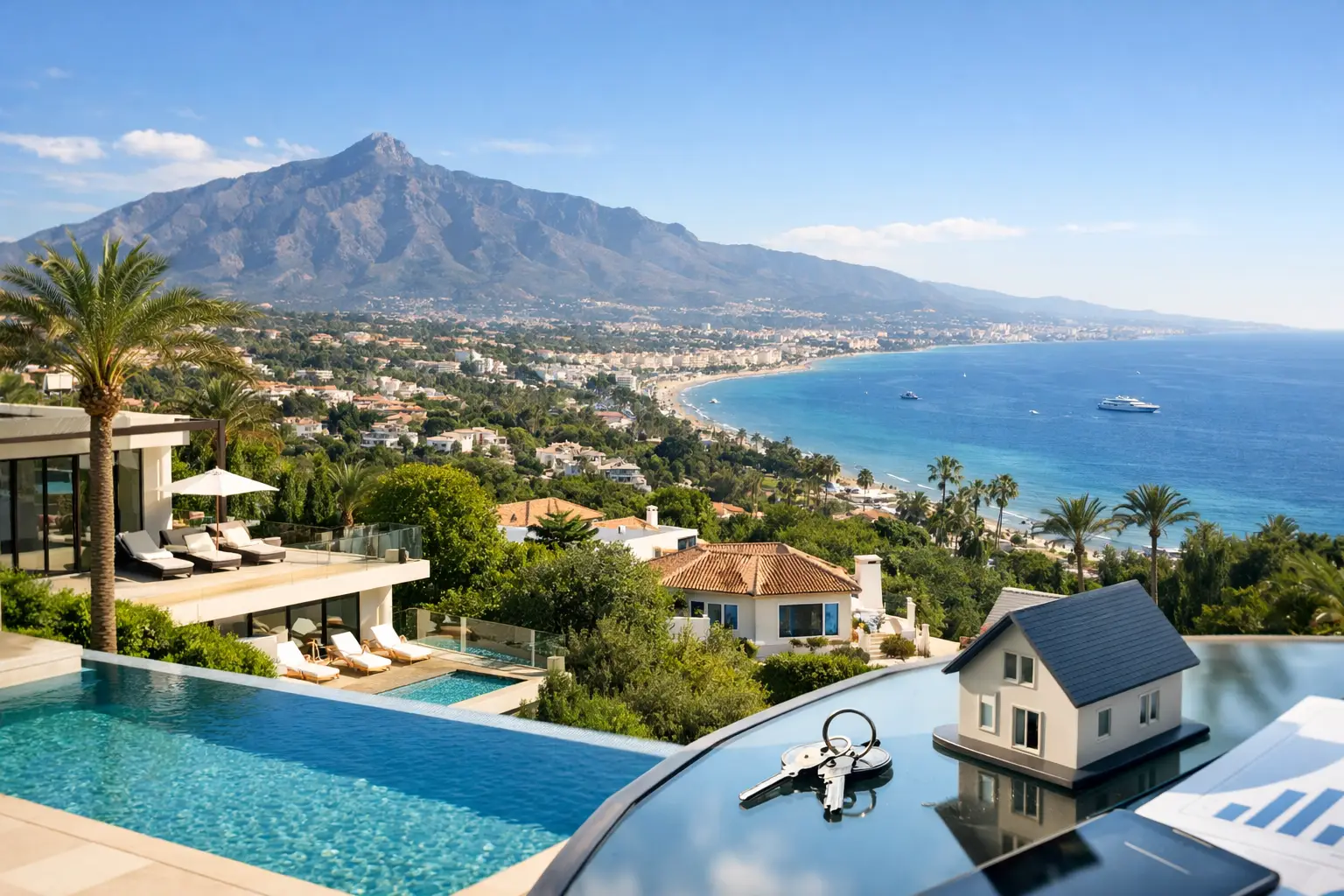
A beachfront villa in Los Monteros, a contemporary home in Sierra Blanca, a branded new-build on the Golden Mile – in Marbella, the gap between ordinary demand and true prime demand has become impossible to ignore. The latest Marbella property market trends point to a market that remains active at the top end, but far more selective in how value is judged, where buyers compete, and which homes command a premium without negotiation.
For international buyers, that distinction matters. Marbella is not one single market. It is a collection of micro-locations, buyer profiles and price bands, each moving at its own pace. When looked at closely, the headline is not simply that demand is strong. It is that demand is increasingly focused on quality, privacy, lifestyle convenience and legal clarity.
Marbella property market trends shaping demand
The strongest trend is sustained international interest in prime residential property. Marbella continues to attract buyers from Northern Europe, the UK, the Middle East and North America, as well as Spanish purchasers seeking a secure second residence in an established luxury destination. This demand is driven by lifestyle, certainly, but also by long-term confidence in Marbella as a proven market with limited frontline supply in its best addresses.
That said, buyers are not behaving indiscriminately. Compared with earlier periods of rapid movement, high-net-worth purchasers are now more precise. They will pay decisively for the right property, but the right property usually means excellent location, contemporary presentation, strong build quality, privacy, security and effortless ownership. Homes that fall short on one or two of those points can still sell, yet often with a longer marketing period and more discussion around price.
This is especially visible in the upper tiers of the market. Best-in-class villas and penthouses continue to attract attention quickly. Secondary stock, even in good areas, requires sharper positioning. In practical terms, this creates a market where headline demand is healthy, but pricing power belongs mainly to properties with few compromises.
Prime areas are moving differently
One of the most important Marbella property market trends is the widening performance gap between prime enclaves and broader surrounding areas. The Golden Mile, Sierra Blanca, Puente Romano, beachfront pockets east of Marbella and select addresses in Benahavís remain highly resilient because they offer scarcity as well as status. Buyers in these locations are purchasing more than square metres. They are buying reputation, proximity, outlook and a level of liquidity that tends to hold up even when wider sentiment softens.
Benahavís, in particular, continues to benefit from buyers who want space, security and elevated views, while remaining within easy reach of Marbella and Puerto Banús. For many families and second-home owners, it offers a compelling balance between privacy and access. Rio Real and Los Monteros appeal to those who prefer a more settled beachfront atmosphere, often with larger plots and a quieter rhythm than the busiest central zones.
The practical implication is straightforward. Marbella should be read neighbourhood by neighbourhood, not by broad municipal averages. A well-positioned home in a tightly held micro-market may see stronger price support than a larger or newer property in a less established setting.
The Golden Mile still sets the tone
If there is one area that continues to define premium pricing, it is the Golden Mile. The combination of beach access, established prestige, five-star amenities and international recognition gives it unusual depth of demand. Both resale and new-build stock perform well here, but stock levels are consistently constrained.
This does not mean every property on the Golden Mile is immune to market pressure. Condition, architecture, service charges, orientation and road noise all matter. Even so, buyers who want a classic Marbella address continue to focus their search here first, which helps explain why standout homes often receive serious interest before they reach broad market saturation.
New-build remains highly sought after
A clear trend across the Costa del Sol is the continued appeal of new-build property, particularly in the luxury segment. In Marbella, this is not simply about modern design. Buyers value energy efficiency, contemporary layouts, home technology, wellness features and lower immediate maintenance obligations. For overseas owners, the appeal of a turnkey residence is especially strong.
New-build premiums have held up because many purchasers are comparing not only aesthetics but also the hidden costs of refurbishing older stock. Renovation in Spain can produce exceptional results, but it requires time, trusted professionals and patience with process. Some buyers welcome that. Many would rather avoid it.
As a result, well-conceived new developments in prime and near-prime locations continue to perform strongly. Yet there is a nuance here. Not every new-build commands the same enthusiasm. Projects with weak positioning, limited privacy or over-ambitious pricing can lose momentum. In Marbella, finish and branding help, but location still decides long-term value.
Limited supply is supporting prices
Across the luxury market, a shortage of truly prime stock remains a defining factor. Owners of exceptional homes are often under little pressure to sell, especially if they purchased before recent price rises or use the property primarily for family enjoyment. That keeps supply tighter than many buyers expect.
This shortage is most visible in frontline beach properties, top-quality villas in secure gated communities and large modern homes close to the sea. When these assets come to market in excellent condition and with clean legal documentation, competition can be intense. In that sense, Marbella continues to behave like a mature prime market rather than a purely speculative one.
For sellers, this can be favourable, but only if pricing is disciplined. Overpricing remains one of the quickest ways to lose momentum, even in a market with constrained supply. Today’s buyer is internationally informed and rarely short of advice.
Price growth is selective, not universal
Another important shift is that price growth is no longer broad-based across every category. Premium segments in prime areas have generally remained firmer than mid-market or compromised stock. Homes with sea views, walking distance to services, refined architecture and strong rental appeal tend to outperform. Properties needing extensive updating, or located in less desirable positions, may still achieve good results, but the route is less straightforward.
This selectivity is healthy. It suggests a market with discernment rather than excess. Buyers are paying for lasting advantages, not merely following momentum.
International buyers still lead, but motivations vary
Foreign demand remains the backbone of Marbella’s prime residential market, though motivations differ. Some buyers are seeking a family holiday residence with concierge support and easy lock-up-and-leave practicality. Others want a semi-permanent or full-time move supported by international schools, healthcare and year-round lifestyle amenities. Investors are present too, although in the luxury market they are often lifestyle investors first and yield investors second.
This distinction matters because it affects what buyers prioritise. A pure investor may focus on rental seasonality, running costs and future resale liquidity. A lifestyle buyer may place greater importance on privacy, leisure access, interior finish and the ease of hosting family and guests. The most desirable homes tend to satisfy both sets of criteria, which is one reason they remain so sought after.
For overseas purchasers, transaction confidence also plays a larger role than many assume. Clear legal checks, accurate property registration, planning certainty and experienced local guidance are not administrative details at this level. They are part of the property’s value proposition. This is where boutique expertise becomes particularly relevant, especially in a market where discretion and precision matter as much as marketing reach.
What buyers and sellers should watch next
Looking ahead, the most likely direction for Marbella is continued resilience in the upper market, supported by limited supply and international wealth migration. But resilience does not mean uniformity. Interest rates, geopolitical sentiment, tax considerations in buyers’ home countries and the timing of new luxury developments can all influence behaviour.
For buyers, patience and readiness are equally important. Waiting for the perfect opportunity can make sense, but in the most tightly held segments, hesitation often carries a cost. For sellers, presentation, timing and exact pricing remain decisive. In a selective market, credibility wins.
At Amrein Properties, we see that the finest results rarely come from chasing noise. They come from understanding the details of each address, each buyer profile and each transaction path. Marbella still offers exceptional opportunity, but the market rewards those who approach it with clear eyes, local knowledge and a long view.
The most useful way to read Marbella now is not to ask whether the market is up or down. It is to ask which properties are becoming rarer, which locations continue to hold their appeal, and which decisions will still look wise five years from now.